- Polio oral history project: Ross Grimmett, Dunedin
- Polio oral history project: Nancy Blackstock, Whanganui
- Polio oral history project: Doug and Rae Hankin, Porirua NZ
- Polio oral history project: John Gourlay, Dunedin
- Polio oral history project: Mervyn Dykes, Upper Hutt
- Polio oral history project: Lorraine Skevington, Waikuku Beach, Christchurch
- Bev Hopkins: Polio stories - personal recollections of the polio epidemic of the 1940s and 1950s
- Joan Saunders: Polio stories - personal recollections of the polio epidemic of the 1940s and 1950s
- Margaret Young: Polio stories - personal recollections of the polio epidemic of the 1940s and 1950s
- Dr Y.R. Krishnaswamy: Polio stories - personal recollections of the polio epidemic of the 1940s and 1950s
 This work is licensed under a Creative Commons Attribution-Noncommercial-No Derivative Works 3.0 New Zealand License


Dunedin Public Libraries and the Dunedin Lebanese Community Present
He Purapura Marara | Scattered Seeds
He Purapura Marara | Scattered Seeds

Menu
Dr Mike Davis: Polio stories - personal recollections of the polio epidemic of the 1940s and 1950s
This recollection was kindly contributed by Dr Mike Davis, who contracted polio at the age of 14 in Portsmouth, England.
Polio story for Francis Michael (“Mike”) Davis
In late August 1958, aged 14, my friend Nick & I were planning to go to the swimming pool but he cried off and I went for a bike ride instead, not feeling 100%. By evening, I felt awful & my temperature was 102O F. Our doctor visited that evening (the good old days of house visits by GPs!). After examining me, he advised my mother that he was worried that I might have polio & to keep me in bed. I fell asleep early and when I woke the following morning I could not move my left leg at all and my right felt weak. I remember being pretty scared by this.
That afternoon I was admitted to the Infectious Diseases Hospital in Portsmouth, England. The only things I remember of the first couple of days in hospital were having to lie in pain flat on my back and the even worse pain of having a lumbar puncture. On the third day, I realised Nick was in the ward too. We always suspected that we caught it at a filthy public toilet on the seafront at Haslar, in Gosport, when we went to the RN air show a week or so previously.
The ward was star-shaped with about eight glass-sided isolation cubicles on our wing, each with a door to the outside. Soon they put us in side-by-side cubicles, where we remained on total bed rest for four weeks. Precious times after the first couple of weeks were being wheeled outside on our beds on sunny days into the early autumn air. During that time, my right leg seemed to get most of its strength back and some movement of my left leg slowly reappeared. Nick & I came to dislike one of the nurses who was always sharp with us, but the rest of the nurses were great. I have no recall of the doctors. The food was awful, fortunately supplemented by parents when they visited (standing at the door of the cubicle).
After four weeks, I commenced physiotherapy, initially non-weight-bearing, then on crutches and finally with walking sticks. My physiotherapist was a close friend of my god parents and I remained in touch with her for several years. Physio was in another building (progress was the day I walked there instead of being taken in a wheelchair!) that housed a huge ward for long-stay, severely paralysed polio patients – iron lungs & chest cuirasses to help patients‟ breathing, etc. I made friends with a 16 y.o. boy who needed the help of a cuirass at night but was okay using his accessory muscles for breathing sitting up during the day. I remember he developed pneumonia at one stage. We played chess together – I‟ve forgotten his name. Soon after I was discharged, he was moved to the Lord Mayor Treloar Cripples' Home at Alton in Hampshire. I caught the bus to visit him there a few times over the next couple of years, but stopped rather selfishly as I found being with him so demoralising; as a teenager it was hard enough dealing with my own disability as I had been heavily into rugby, soccer, cricket, tennis, golf, cycling and roller skating. I still feel guilty about this.
I was discharged home after two months in hospital, walking with the aid of two sticks. Just before discharge two officious strangers turned up to “measure me for a full leg brace” − fortunately, I had sufficient working buttock muscles to have a stable left hip for weight-bearing & they abandoned the plan. This frightening experience left me with a life-long antipathy towards ever wearing braces or splints!
Four times a week an ambulance picked me up (my mother did not have a car) to go to outpatient physio at the Queen Alexandra Hospital two afternoons and the RN swimming pool for hydrotherapy two mornings. This lasted for about a year, during which my right leg regained full strength. My left leg remained quite severely paretic, different muscle groups varying from 1 to 3 on the MRC muscle power scale (0 – 6). Worst affected were my quads (1), hip flexors (2) & adductors (2). My abdominal and paravertebral muscles on the left were also affected, so I‟ve never been able to do sit-ups since. I also realise now that urinary urgency and frequency that I‟ve had all my adult life stems from then. I missed a full term of school, but had some private tuition in physics that got me through the O-level exam.
My physiotherapist was an amazing man – Frank Collier – for whom I had immense respect. He was in his early 60s, with the body of a 30 y.o. He was an ex-Army PT instructor & had been a member of the British Army gymnastics team. As you might imagine, he was a hard task master (he had me in tears a number of times) but had a heart of gold and was absolutely dedicated to his work. Mr Collier was years ahead of his time (remember this is the late 50s), employing hydrotherapy as a core component of rehabilitation for polio victims and other handicaps. Whilst the dozen or so „victims‟ exercised at the shallow end, a man in his 40s used to come in on his callipers and crutches, change, drag himself on his backside to the edge of the pool & flop in. He then swam freestyle up and down the pool for nearly an hour without stopping. I soon got bored with the pool exercises & asked Mr Collier if I could swim with him, which I did.
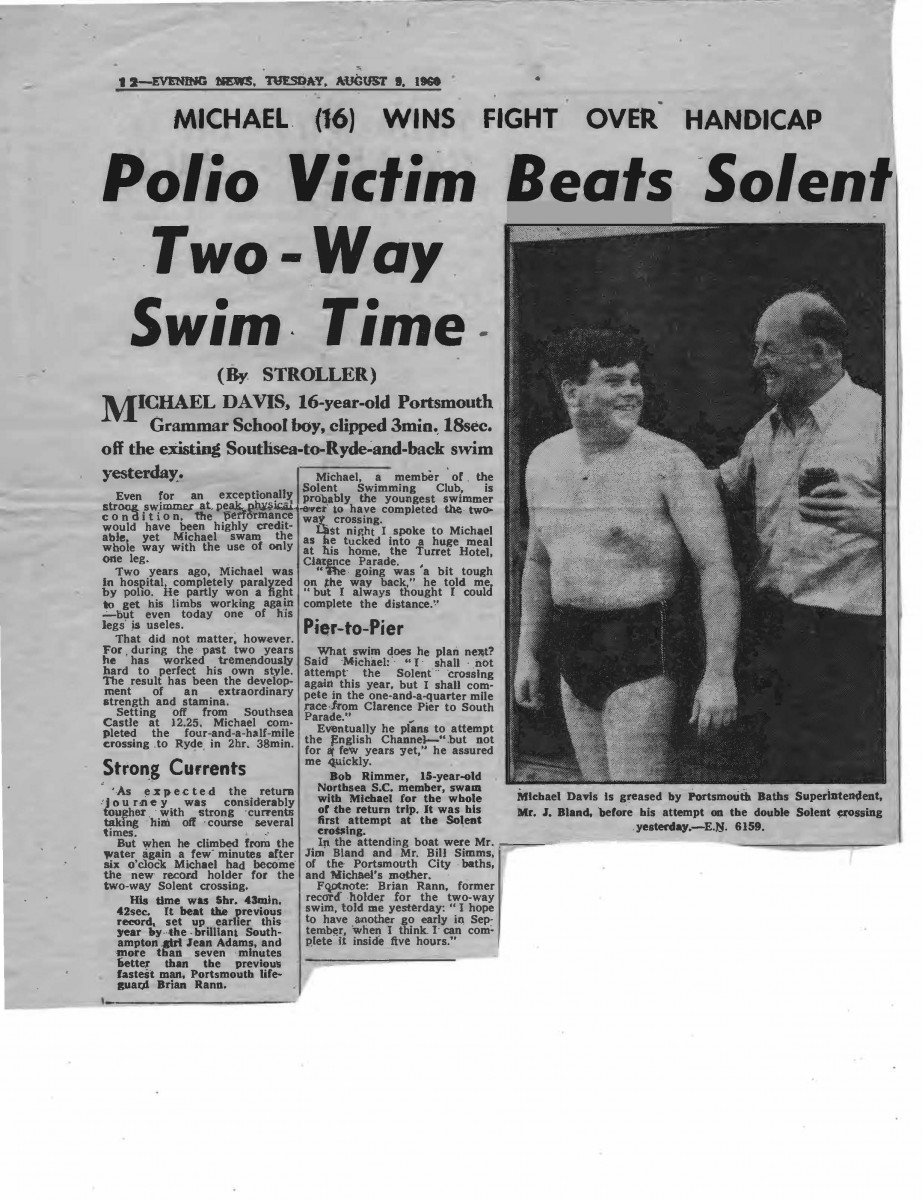
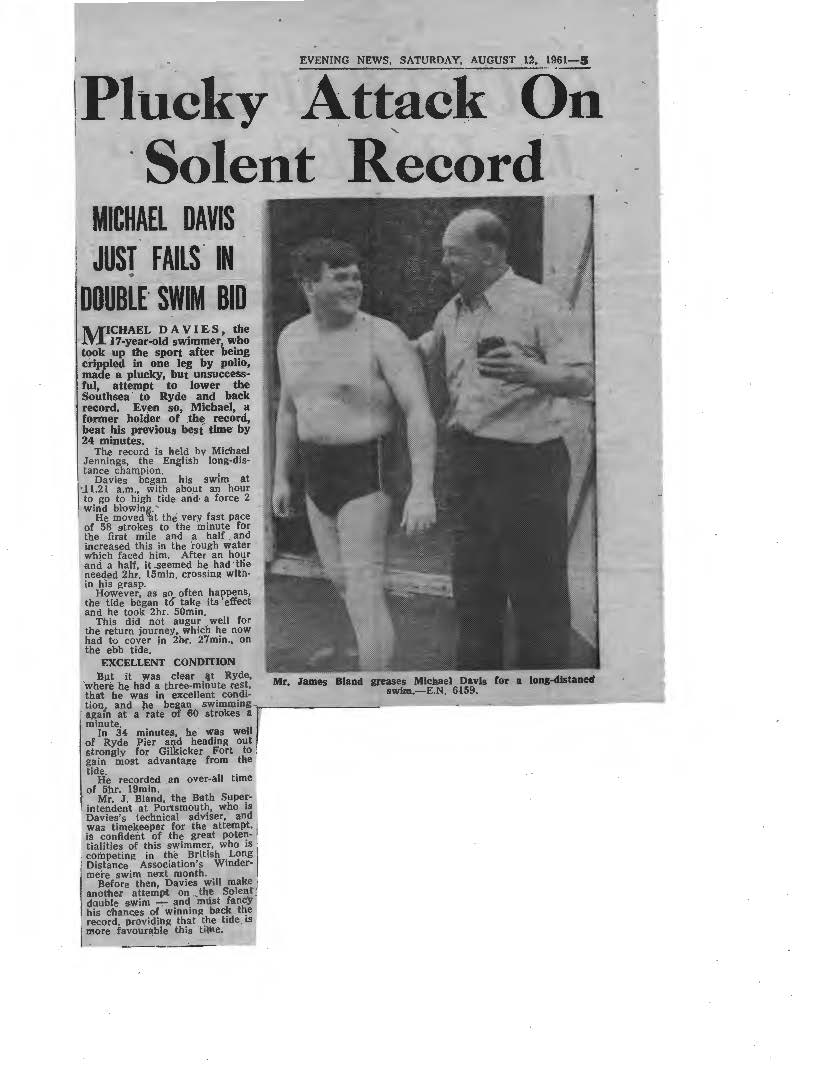
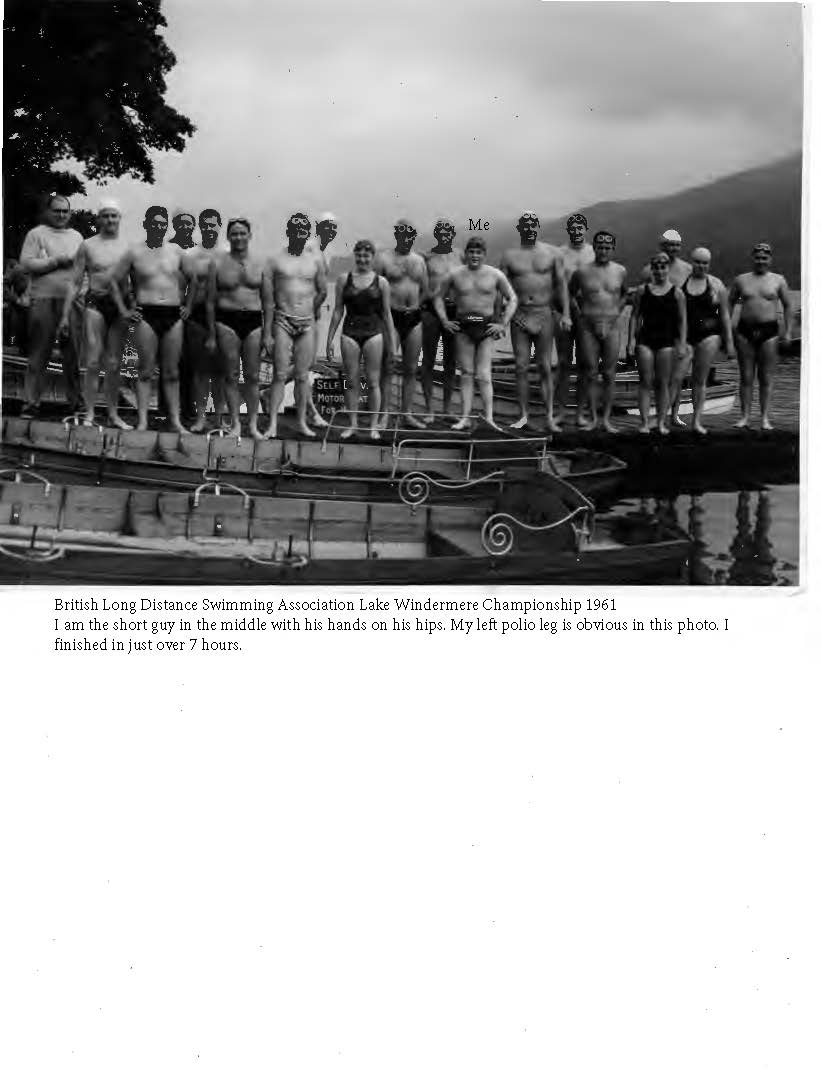
From then on swimming and water sports – water polo, underwater hockey, underwater rugby, freediving, spearfishing and scuba diving – became a major part of my life and at age 78 I still swim 1500 m three times a week. A year after contracting polio, I did a 2 hr sea swim and the year after that I swam across the Solent from Southsea to Ryde on the Isle of Wight. The following year, I broke the two-way record for the Solent crossing and swam the length of Lake Windemere in the Lake District in just over seven hours.
You asked a number of specific questions, which I will try to answer.
How did you first hear about the epidemic? I don‟t remember, but it was common knowledge, just like Covid is today.
When did it become real for you? The morning I woke up with a paralysed leg!!
How did it feel to realise polio was spreading – how did your family and friends react? I don‟t remember.
What precautions, if any, did you or your family take to protect yourselves? Again, I don‟t remember, but we knew the vaccine was coming. Half my school were vaccinated in the summer term of 1958 and the other half, including Nick & me, were due in the autumn term. We caught polio in the summer holiday between the two terms.
Were you affected personally by the disease and how? See above. As you can imagine, as a very active teenager, getting polio & ending up with a severely paretic leg had a massive impact on my psyche, but I quickly became determined that it would not stop me leading life to the full. It is only now in my 70s that it has finally caught up with me, limiting my activities a fair bit. I never gave license to the view that “overdoing it” would only make things worse, quite the contrary! For most of my life, I had feelings of anger and shame at catching polio. For many years I thought of it as a punishment for being too proud of my physical prowess amongst my peers – a silly view, but there it is, we all have our daft moments, don‟t we? Perhaps the most important impact, however, is that it made me determined to become a doctor, so it has shaped my entire life since that August morning.
Do you have any experiences of the hospitals or medical care? See above.
How did you hear about the Salk vaccination, and how did that affect you and your family when you learned it could be effective in halting the epidemic? See above.
What was the process for distributing the vaccine? Unlike the modern day stupidity regarding vaccines, as far as I recall, everyone just got their children vaccinated. I assume the UK Government‟s policy at the time was to do this through the schools, like my school.
What is your experience of long-term polio sufferers, for whom the vaccine came too late? Over the years one comes across others who have residual paresis of varying degrees. My overall impression has been that, like me, they try to take life in their stride, whatever their degree of paresis. As an anaesthetist, I looked after polio sufferers periodically. As time went on, a few became „regulars‟ on my orthopaedic lists as their musculoskeletal systems deteriorated with age. I have never come across anyone, socially or medically with a “post-polio syndrome”. My professional reading and my personal experiences convince me that this is an uncommon entity; the deterioration that occurs with time is primarily that associated with aging in a milieu interieur of diminished reserves in motor units.
How has your experience of the polio epidemic prepared you (if at all) for the current COVID-19 pandemic? N.B. The following is also strongly coloured by my medical training and experience. Double-vacc‟ed & double boosted at the earliest opportunities; mask worn ++; hand washing ++; social distancing on and off for many months over the past 2½ years as each wave has hit! Anger at the anti-vaccine mob (including a few medical colleagues, sadly) – whilst a small minority have rational/medical reasons not to get vaccinated, I have no patience with the majority! As an example of such stupidity, as an intensive care specialist in the 1980s, I helped look after a 10-month-old baby with whooping cough. The child died despite all our cares − a totally avoidable tragedy. The baby‟s father was an anti-vaccination GP.
It was an interesting exercise to sit down & write this as, despite the daily physical frustrations & discomfort, I have never thought of myself as a "victim". I'm one of the lucky ones with only a mono-paresis
 Date26th July 2022External linkWebsite for Polio NZ
School of Physiotherapy, University of Otago,
https://otago.ourheritage.ac.nz/items/show/7975
PoliomyelitisPoliomyelitis - New ZealandPoliomyelitis - New Zealand - HistoryPostpoliomyelitis syndrome - New ZealandAudioPolio oral history project: Ross Grimmett, DunedinPolio oral history project: Nancy Blackstock, WhanganuiPolio oral history project: Doug and Rae Hankin, Porirua NZPolio oral history project: John Gourlay, DunedinPolio oral history project: Mervyn Dykes, Upper HuttPolio oral history project: Lorraine Skevington, Waikuku Beach, ChristchurchStoriesBev Hopkins: Polio stories - personal recollections of the polio epidemic of the 1940s and 1950sJoan Saunders: Polio stories - personal recollections of the polio epidemic of the 1940s and 1950sMargaret Young: Polio stories - personal recollections of the polio epidemic of the 1940s and 1950sDr Y.R. Krishnaswamy: Polio stories - personal recollections of the polio epidemic of the 1940s and 1950sKay Mercer